
Visitors from other countries are often surprised by American restroom stalls. The visible gaps around doors and beneath panels feel deliberate, yet they are not. They are a byproduct of how the industry developed.
Understanding the origin of these gaps explains why they persist. It also clarifies why solving them requires a different approach than minor adjustments. The history is more about manufacturing than about design intent.
Where Did the Gaps Come From?
The gaps trace back to modular manufacturing and field installation. Commercial partitions are mass-produced in standard panel widths and shipped to a jobsite for assembly. There they meet walls that may not be perfectly plumb, level, or square.
The gaps on the hinge and latch sides let the door swing without binding. The gap beneath the panel simplifies cleaning and signals occupancy. Each gap solves a practical problem while creating a privacy one.
Why Did This System Become Standard?
The modular system won out because it is fast, affordable, and forgiving. It can be manufactured cheaply, shipped efficiently, and installed quickly across varied conditions. Those advantages shaped the entire American market.
Early off-the-floor partition designs prioritized maintenance access and airflow. That foundational approach valued cleaning and ventilation over occupant privacy. The market has largely followed that template ever since.
How Do European Stalls Differ?
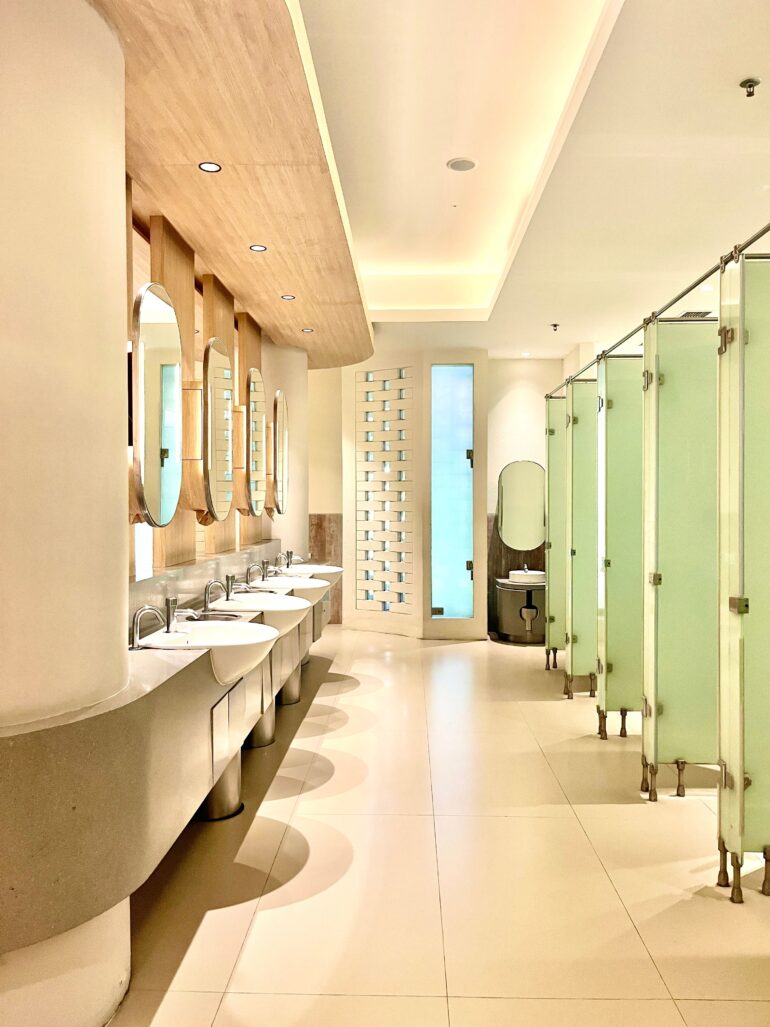
European restrooms take a fundamentally different approach. They typically use cubicle systems with full-height doors that minimize or eliminate sightline gaps. The difference is structural rather than cultural.
An industry analysis of this divide documents how rabbeted door edges and floor-to-ceiling construction deliver the kind of enclosure American occupants now request, and it argues that commercial restroom privacy can be engineered into the system rather than treated as a premium add-on. The report traces the contrast directly to manufacturing methods.
European construction historically used fixed cubicle systems built into the room. That approach raises material cost and installation time. In exchange, it delivers a markedly different privacy experience.
What Tradeoffs Did the American Approach Accept?
The American system accepted reduced privacy in favor of efficiency. The tradeoffs it embraced are worth naming clearly:
- Lower manufacturing cost through standard panel sizes
- Faster installation across imperfect wall conditions
- Simplified cleaning with off-the-floor panels
- Visible occupancy indication through door gaps
- Reduced privacy as the unintended consequence
These tradeoffs made sense for a market focused on speed and cost. They are also why the privacy shortfall has been so persistent. The system optimized for everything except enclosure.

Can the Legacy Be Overcome?
The legacy can be overcome with modern partition design. Newer systems are engineered to close sightline gaps while retaining the practicality of modular installation. Privacy no longer requires abandoning the efficiencies that built the market.
The key is specifying for privacy from the start. When enclosure is a design requirement, the right products are selected early. That timing keeps the solution practical and affordable.
What Has Changed in Modern Partition Systems?
Modern partition systems have closed much of the gap between efficiency and enclosure. Engineered door edges, interlocking panels, and tighter tolerances now deliver privacy without abandoning modular installation. The historical tradeoff is no longer a fixed constraint.
This evolution means specifiers no longer have to choose between cost and privacy. The same speed of installation can coexist with full enclosure. What was once a premium exception is becoming a practical standard.
The gaps in American restrooms are an artifact of manufacturing history, not a fixed feature of the format. They emerged from priorities that no longer match occupant expectations.
For specifiers, recognizing this history clarifies the path forward. The same modular efficiency can now coexist with the privacy occupants increasingly demand.