A roll-off container staged at a gut-demolition job. Volume is what the customer rents. Weight is what the hauler pays for.
Almost every roll-off dumpster in the country is advertised the same way, by the cubic yard. Fifteen yards, twenty yards, thirty yards.
The number describes the size of the steel box that ends up in the driveway, and for most customers it is the only number in the transaction they ever really think about.
The disposal side of that transaction does not work in cubic yards at all. Landfills charge by the ton. That mismatch, between the unit a customer shops in and the unit the industry actually pays in, explains most of the surprise line items on a final dumpster invoice.
A ton is not a fixed price
There is a common assumption that disposal is roughly the same everywhere, a background cost that does not vary much. The data does not support it.
The Environmental Research and Education Foundation maintains a national database of municipal solid waste landfills and publishes an annual analysis of what those facilities charge at the gate. Its 2023 study surveyed 515 landfills and obtained gate rates from 342 of them. BioCycle’s detailed breakdown of the 2023 landfill tip fee findings lays out the spread.
The national unweighted average came to $56.80 per ton, down about 3 percent from $58.47 the year before. That average conceals a great deal.
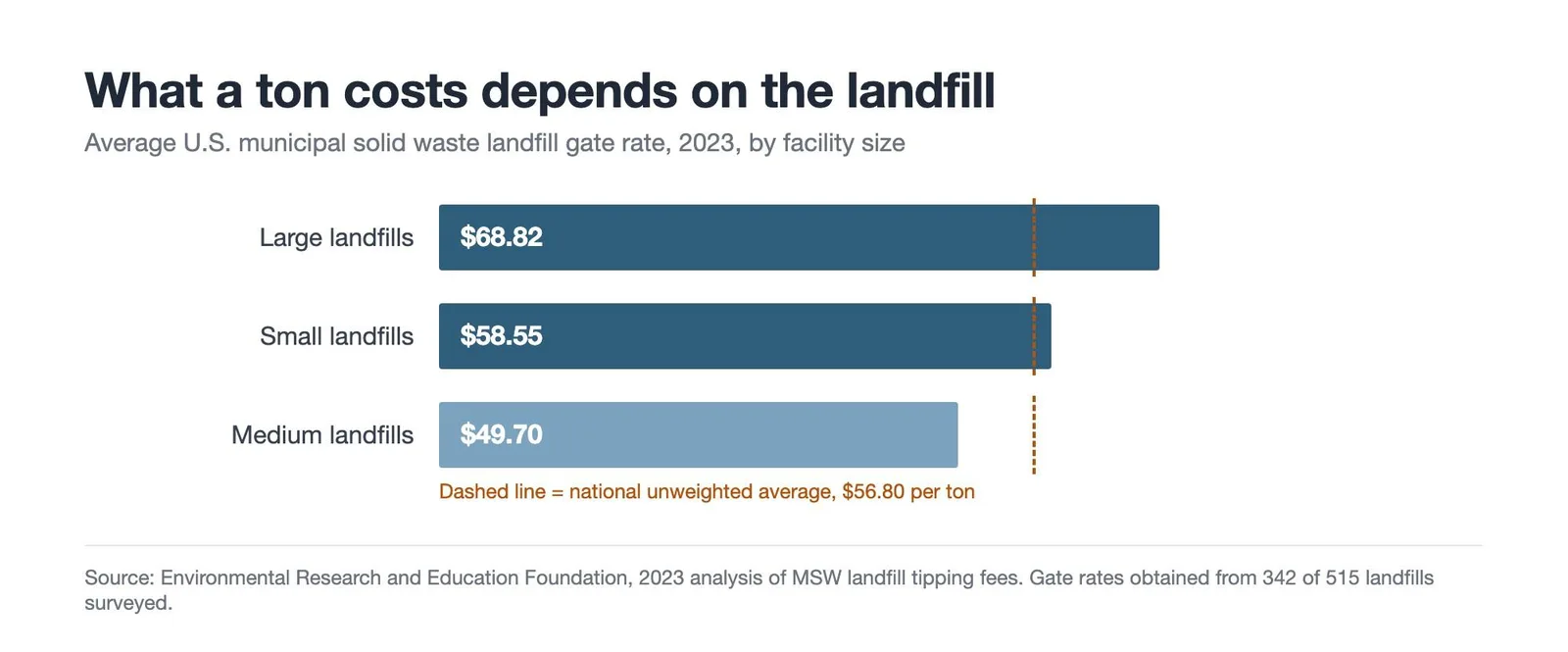 Large landfills, which handle most of the country’s municipal solid waste, are also the most expensive place to put a ton.
Sorted by facility size, large landfills averaged $68.82 per ton, small landfills $58.55, and medium landfills $49.70. The largest sites, which the foundation estimates handle 56 percent of the country’s municipal solid waste, were also the most expensive place to put a ton.
The regional gap is wider still. In 2023 the Northeast averaged $84.44 per ton after a $7.52 increase, while the Pacific region averaged $62.28 after a decline. Same year, same unit, a difference of more than twenty dollars a ton depending on geography.
None of that variation is visible in a container listing. The cubic yards are identical from market to market. The tons underneath them are not.
Why construction debris breaks the mental model
The volume-versus-weight gap is widest on exactly the jobs where people rent the largest containers.
The Environmental Protection Agency’s accounting of construction and demolition debris generation and where it ends up puts the annual U.S. total at roughly 600 million tons, more than twice the country’s municipal solid waste. Of that, about 457 million tons went on to a next use and roughly 144 million tons went to landfills.
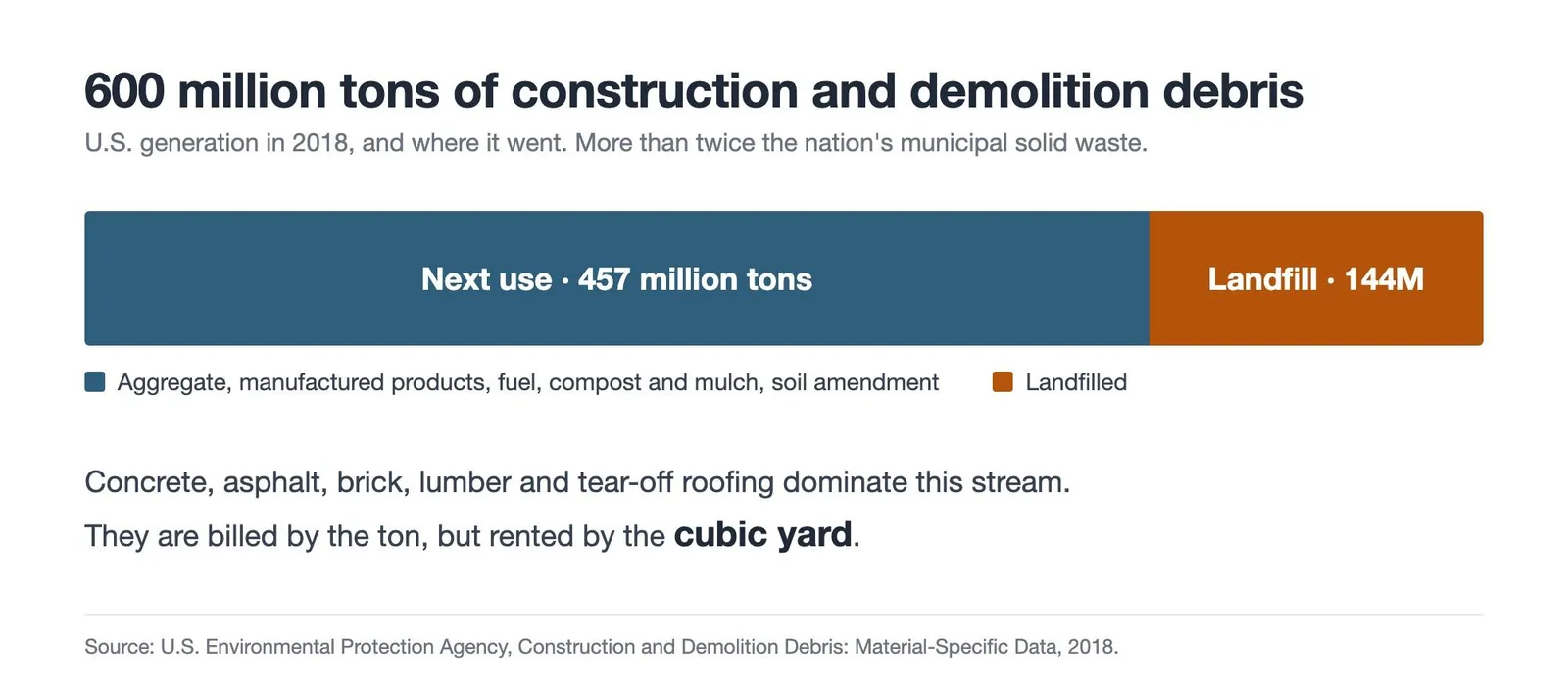 Construction and demolition debris is roughly twice the tonnage of municipal solid waste, and far denser per cubic yard.
Those proportions describe a waste stream dominated by dense material. Concrete, asphalt, brick, dimensional lumber, and tear-off roofing behave nothing like the couches and cardboard of a household cleanout.
A thirty-yard box filled with furniture, boxes, and bagged clothing may never approach its weight allowance. The same box, filled a third of the way with shingles or broken concrete, can pass it comfortably.
Both customers rented “a thirty-yard dumpster.” Only one of them is going to see an overage line.
What the overage line actually is
An overage charge is not a penalty in any meaningful sense. It is the hauler passing along a scale ticket.
Every loaded container gets weighed. The rental price includes a tonnage allowance, and that allowance exists because the hauler has to pre-purchase a certain amount of disposal in order to quote a flat number at all.
Anything past the allowance is billed per ton, because that is precisely how the landfill billed the hauler. Given the regional and facility-size spread above, the per-ton figure a customer sees is a fairly direct reflection of which gate their debris is going through.

Where this goes wrong is not the arithmetic. It is placement. The cubic yards are in the headline. The tonnage allowance sits further down the page, and the per-ton overage rate often sits further down still.
A customer comparing two quotes on size alone is comparing boxes, not disposal. Two containers of identical volume with different weight allowances are not the same product, and on a heavy job they will not produce similar invoices.
Some regional operators have started putting the weight figure up front rather than burying it. Clean Slate Dumpsters, which serves the Hammond area in southeast Louisiana, publishes a plain-language breakdown of how tonnage allowances and overage fees work on a roll-off rental, including which materials tend to consume an allowance fastest. That kind of disclosure is still closer to the exception than the norm.
A more useful question than “what size”
For anyone planning a project, the sequence worth reversing is the obvious one.
“What size do I need?” is a question about whether the material will physically fit. It is worth answering second.
“How heavy is what I am throwing away” is a question about what the job will cost, and it is worth answering first.
Roofing tear-offs, concrete, tile, plaster, dirt, and masonry are the materials that reliably turn a volume estimate into a weight problem. Mixed household goods rarely do.
A contractor who knows the tonnage allowance and the per-ton rate before the container is dropped can price disposal into the bid instead of absorbing it afterward.
None of this requires the industry to change how it advertises. Cubic yards are a reasonable way to describe a steel box, and customers have learned to shop in them.
It does require reading one line further down the quote. The tonnage allowance is the number that determines what the job costs. The cubic yards determine whether the material fits. Those are two different questions, and they have been for a long time.