By Clint Sanchez
Most small business owners do not run on a steady monthly paycheck. Money arrives in bursts, bills arrive on schedule, and the gap between the two is where a lot of decisions get made.
That gap shows up clearly in the latest federal data. It also explains why so many owners now ask a practical question before any new purchase, including a website: is it better to pay once or pay every month?
What the Federal Reserve Survey Found
The 12 Federal Reserve Banks run the Small Business Credit Survey every year. Their 2026 Report on Employer Firms draws on 6,525 responses from firms with 1 to 499 employees across all 50 states and the District of Columbia, collected from September 3 to November 14, 2025.
Firms of that size made up 99.7% of employer establishments in the country in 2023, according to the report. So the survey speaks to the businesses most owners would call small.
The headline financial challenge was rising costs, cited by 73% of firms. Close behind were paying operating expenses at 54% and uneven cash flow at 50%. The survey counts trouble collecting on receivables as part of uneven cash flow.
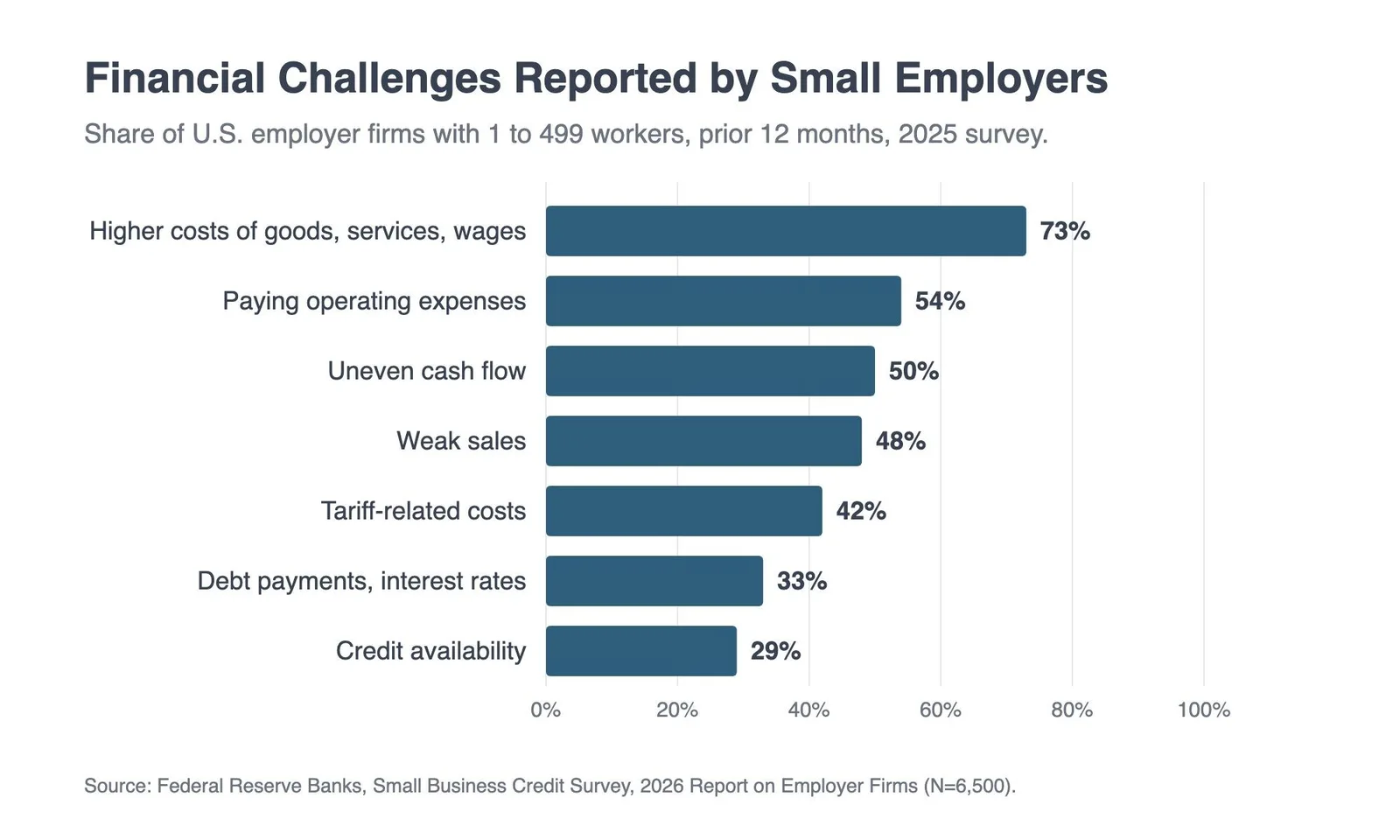
Financial challenges reported by small employer firms, prior 12 months, 2025 survey.
The Reserve Banks note that the survey is a convenience sample, not a random one, and that its results are weighted to represent the national population of small employer firms. It works as a strong signal of conditions, not a precise census.
How Owners Cover the Gaps
The more telling numbers describe what firms did about it. Among employers that reported a financial challenge, 54% used the owner’s personal funds. Another 47% drew on cash reserves, and 36% took out debt.
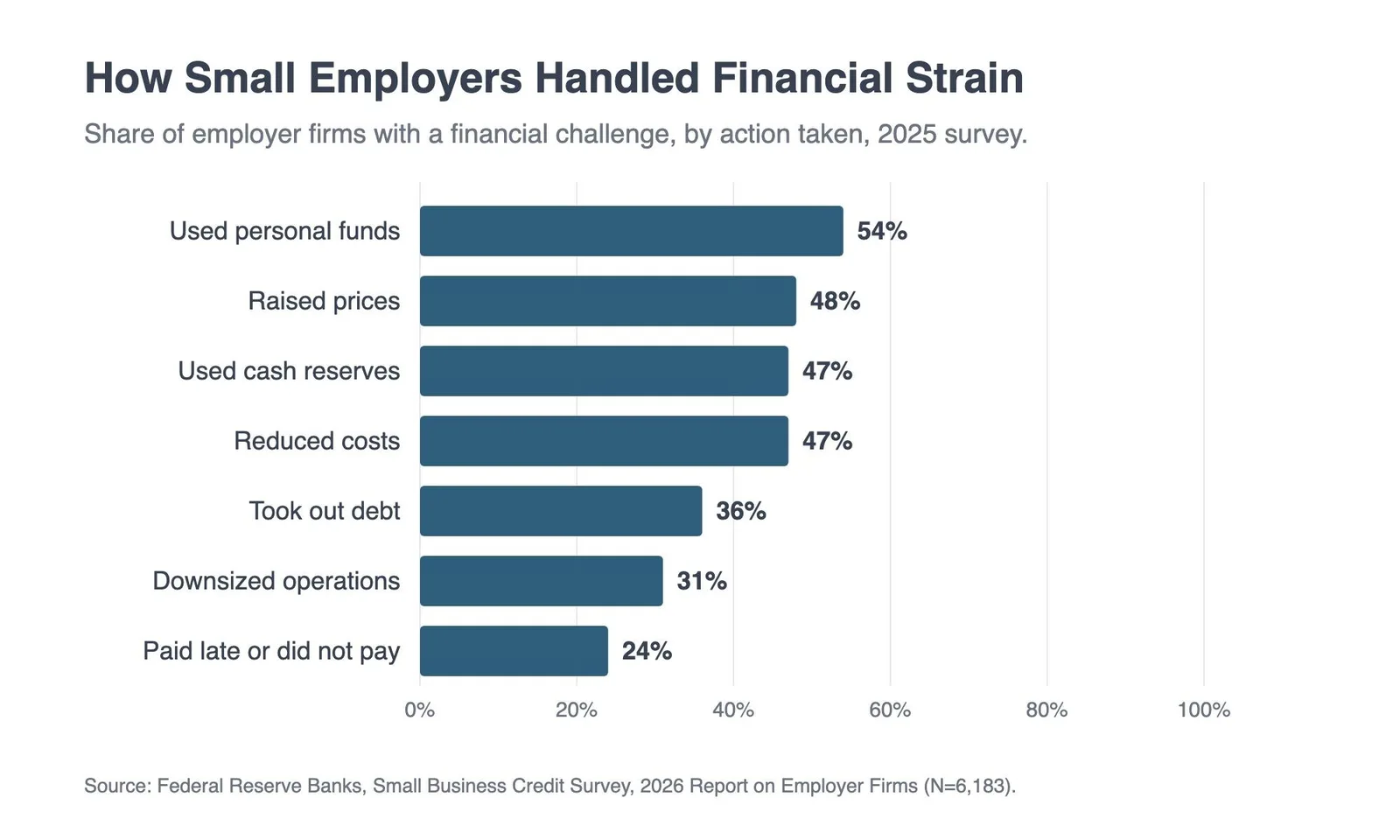
Actions taken in response to financial challenges, 2025 survey.
Cost-cutting was just as common, at 47%. The questionnaire lists cutting advertising as one example of reducing costs, which matters for any owner treating marketing as an optional line item. Roughly one in four firms with a challenge made a late payment or did not pay a bill at all.
Owners without employees lean on personal money even more. A companion Federal Reserve report on firms with no employees found that 64% relied on the owner’s personal funds to deal with financial challenges, compared with 54% of employer firms.
Why the Payment Model Matters
Read together, those figures describe a common position. Many owners have expenses that are fixed and income that is not, and when the two collide, the owner’s own savings fill the hole.
For that owner, a large one-time charge and a smaller recurring charge are not just two prices. They are two different cash-flow shapes. One hits a single month hard. The other spreads the cost and becomes one more bill that has to be met in a slow month.
Neither shape is right for everyone. A business with cash on hand may prefer to pay once and carry fewer recurring bills. A business with lumpy income may prefer a predictable monthly line. The survey cannot settle that choice, but it does show why the question is real for a large share of owners.
What a Monthly Plan Should Put in Writing
Recurring website plans vary widely in what they include and what happens when they end. The monthly figure alone says little. The written terms say most of it.
The domain name comes first. Under ICANN’s published registrants’ benefits and responsibilities, every registration sits under an agreement with an accredited registrar, and the registrant assumes sole responsibility for the name. The registrant can review that agreement at any time and is entitled to information on how to transfer and renew the name.
That makes one detail worth checking: whose name is on the registration. If the domain is registered to the business, the business controls it. ICANN also says registrants must answer registrar inquiries within 15 days and keep payment details current if a name renews automatically, so the contact email on file should reach someone who reads it.

The site itself is the next question. A written plan should say who owns the text, the photos, and the design files. It should also say how the business gets a full copy of the site when the plan ends.
The service side should be spelled out too. Owners can look for plain answers on hosting, security certificates, backups, software updates, and how content edits are handled, along with what counts as an extra charge.
Exit Terms Are Part of the Price
The end of a contract is easy to skip when signing. It deserves the closest reading.
Useful questions include how much notice is needed to cancel, if there is a minimum term, and what is handed over on the way out. That handover list should cover the domain, the site files, any forms and the data they collected, and the logins for any connected accounts such as analytics.
Owners can also do simple arithmetic before signing. Multiply the monthly fee by the number of months in the term, add any setup or cancellation fees, and compare that total with the cost of paying once plus separate hosting and maintenance. The answer will differ for every business, but doing the math turns a sales conversation into a budgeting one.
Owners weighing the two approaches can read a breakdown of monthly website plans for small businesses and set it next to the checklist above.
The Bigger Pressure Behind the Decision
The same survey points to why owners keep spending on their online presence even in tight months. Reaching customers and growing sales was the most common operational challenge, reported by 57% of employer firms.
Technology was a challenge for 29%, a category the survey defines to include website issues along with e-commerce, cybersecurity, and social media. For many small firms, the website is both a sales tool and a recurring headache.
That combination is unlikely to change soon. What owners can control is the paperwork. A plan that matches the business’s cash flow, keeps the domain and content in the owner’s hands, and states plainly how to leave is a sound starting point, however the bill is paid.